For teams that spend on more than one ad platform and get three numbers that disagree.
Ask. Get the number, the source and the check.
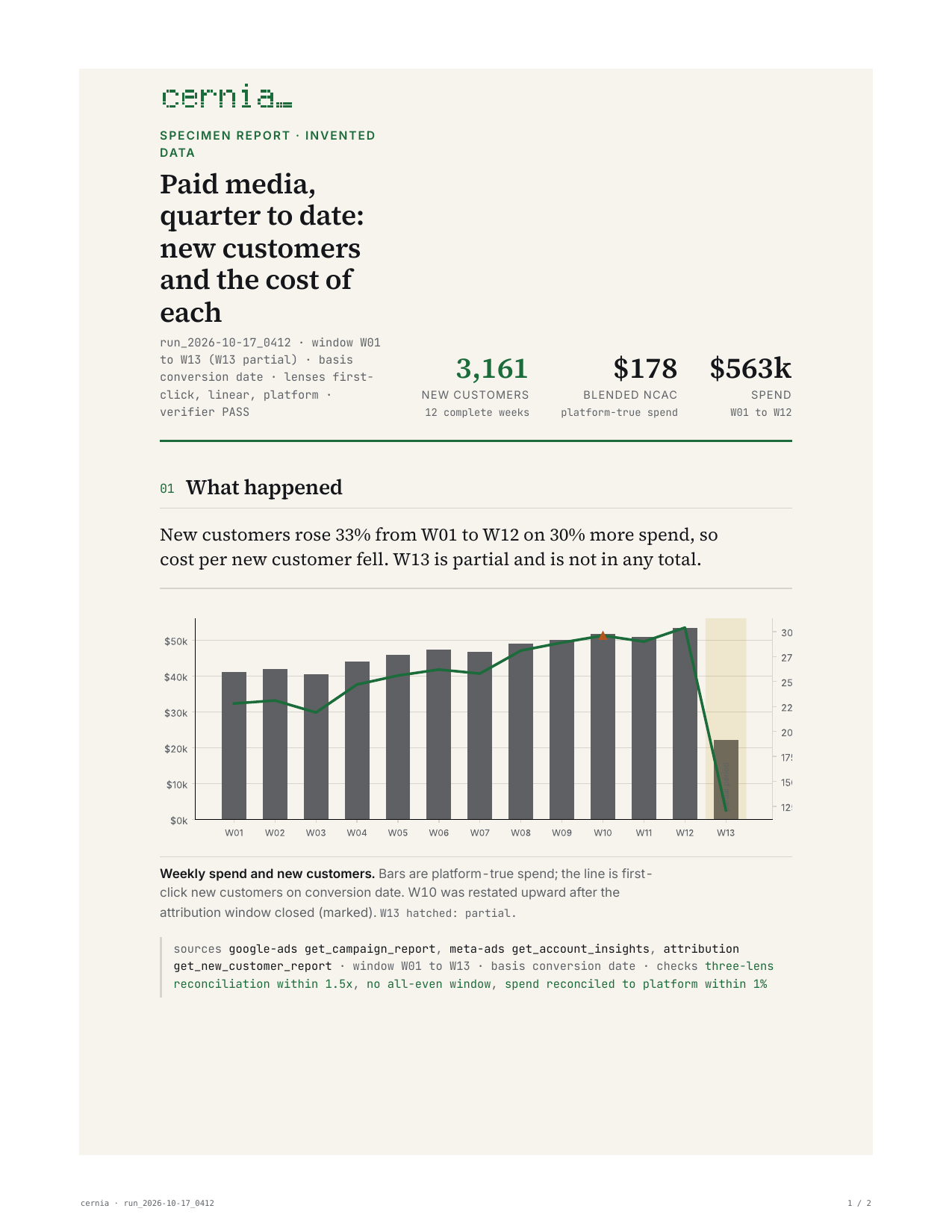
Cernia reads your live ad, analytics and attribution data, answers in minutes, and writes the report your leadership actually reads.
The attribution tool you already have, experiments with stop rules and a Bayesian media-mix model, reconciled in one answer. Then the budget move, drafted for your approval.
A budget constraint, not a demand change. Four of seven days capped by early afternoon; brand and Performance Max unchanged.
Every answer shows what it checked.
Platforms grade their own work. Cernia reconciles three attribution lenses, takes cost from the platform itself, and never turns one alarm into a conclusion. These six rules run in code, on every answer.
| Non-brand search, new customers | W40 | W41 | W41 vs W40 | In the answer |
|---|---|---|---|---|
| First-click (your attribution tool) | 1,363 | 1,118 | −18% | used, as the floor |
| Linear (your attribution tool) | 1,267 | 1,064 | −16% | compared, agrees |
| Platform-reported (Google Ads) | 1,748 | 1,677 | −4% | shown, not used: 1.5x the floor |
three lenses for the question in the specimen above · invented figures · the platform's count is a health signal, so its smaller drop does not soften the conclusion
- Attribution is the floor. Your attribution tool's click credit is each channel's floor. Platform-reported conversions are a health signal, not revenue.
- Cost comes from the platform. Spend is read from the ad platform, never from an attribution tool's cost import. No cost, no cost-per-anything printed.
- Clicks, not views, for social. View-through credit is excluded unless you ask for it, and then it is labelled.
- Fresh campaigns on conversion date. A recently raised campaign is graded on when orders happened, not when clicks did.
- Three lenses, reconciled. First-click, linear and platform numbers are compared before any conclusion is drawn; the disagreement is shown.
- One alarm is never a conclusion. A drop is checked against processing lag, hourly completeness and an independent control before anyone is told traffic fell.
This quarter, next to last year, at every grain.
Every dashboard figure and every recurring-report figure is kept as a series at daily, weekly, monthly, quarterly and yearly grain. When a platform restates history, the old point stays and the change is marked.
| Channel | Spend | New customers | nCAC |
|---|---|---|---|
| Non-brand search | $184,220 | 1,118 | $164.78 |
| Performance Max | $71,905 | 603 | $119.25 |
| Paid social (click only) | $96,410 | 452 | $213.30 ▴ |
| Second-engine search | $23,870 | 141 | $169.29 |
invented figures · ▴ restated after the attribution window closed
Budget moves, campaign builds and experiments, with a person's yes on every change.
Cernia drafts the move, shows the plan with its ID, and applies it only after an approver says yes to that plan. New objects start paused. Nothing is deleted. Budgets, bids and targeting are not touched until you decide they should be.
- 1Plan
Every change listed: object, field, before, after, with a hash and a 24-hour expiry.
PLAN-…-03 · 2 fields - 2Approve
An approver says yes to the plan ID, in the app. Never a channel identity.
approved · in the app - 3Apply
Each field is re-read first; if anything moved since the plan, that step refuses.
re-read ok · applied - 4Read back
The platform is queried again and the diff is kept next to the plan.
diff kept · matches plan - 5Roll back
A rollback plan is written before the first change and approved the same way.
PLAN-20261017-03R · ready
Monthly reallocation
New-customer-first budget moves inside guardrails: protected brand campaigns, a lifetime-value gate, change caps, a paid-search floor. Spend-neutral by default.
Experiments with stop rules
Campaign experiments and geo holdouts are registered with their halt criteria before they start, and sized by power analysis so the read is real.
Media-mix model, additive
A Bayesian model on your own weekly data measures what clicks cannot see. It only adds to attribution and never lowers click credit; channels it cannot read are flagged, not quoted.
Works with the attribution tool you already have. No new pixel.
Cernia connects to the platforms you spend and measure on, reads them live when a question is asked, and keeps nothing it has not declared. You can run it on your own model account too.
keys stay in the vault · decrypted inside the request that uses them · nothing copied
- Search and shoppingGoogle Ads, Microsoft Advertising, Apple Search Ads
- SocialMeta, X; TikTok, LinkedIn, Pinterest, Reddit on the roadmap
- Analytics and organicGA4, Google Search Console, Bing Webmaster Tools
- AttributionWicked Reports today; any attribution platform with an API through an adapter
- LifecycleKlaviyo; commerce and CRM platforms on the roadmap
- Anything else with an APIA new connector typically runs within a day
Where your data goes
Credentials are granted through each platform's own sign-in where it offers one, and entered once where it does not. They are encrypted with a key Cernia controls, decrypted only inside the request that uses them, and never written to a log, a report or a message.
Which model sees what
Answers are produced by a model you choose. Run on Cernia's account, or register your own Anthropic or OpenAI key and run on your own tokens. Rows from your platforms are summarised by scripts before a model reads them; customer contact data is never read.
What is kept
Only what is declared: your dashboard series, report figures, plans and their read-backs, and the audit log of who asked, approved and applied what. Everything else is pulled live and discarded.
It earns its keep from the first day.
You provide read access to each platform, your definitions (what counts as a new customer, your attribution model, revenue basis, goals), and one person who approves changes.
- Day one
- Connections verified, a data-health report for every platform, a first audit of each account.
- Week one
- A cross-platform paid-media review with spend-neutral moves, a tracking and attribution integrity report, your weekly report scripted to your format, a list of quick wins.
- Month one
- The budget engine calibrated to your data, recurring reports and dashboards live, your team asking questions in Slack, and a first media-mix model where three years of weekly data exist.
Cernia is working with a small number of businesses while it grows. Write and say which platforms you spend on.
hello@cernia.ai